Last Friday night two people and two dogs died in a boating accident on Skull Creek.
I learned of this from the news online the following morning. There were few details other than reports of the deaths and that two other people on the boat survived and were taken to Hilton Head Hospital.
I speculated that the boat was a small power boat moving at high speed in darkness that ran into something. However there is not much to run into on Skull Creek other than the supports for the only bridge onto the island. I also wondered if the operator might have been under the influence of something.
Few new details have yet emerged, but the dead have been identified as a husband and wife, aged 76 and 73. who lived on the mainland in nearby Bluffton. Reportedly the husband was operating the boat. I am not including their names. The accident occurred about 9 PM and to my surprise it happened outside our windows. I was not aware of it at the time.
The preliminary investigation indicates that the boat struck a day marker on the Intracoastal Waterway just north of Skull Creek Marina. Most of the markers on the Intracoastal are lighted. We see the red and green lights from our condo. But shoals shift and a year or so ago a new green marker post was placed a few hundred yards from the marina. It was this marker that I anchored inside of when the battery died on the Evo on my last sail. I do not know as a fact that this is the one they hit, but think it likely. I do not recall if there is a light on it. Perhaps not.
There are not yet more facts.
Some media reports call the accident tragic and go on to alarm readers of the "dangers of boating after dark." I am not sure the accident was tragic, except for the dogs, unless you consider all human error tragic. I am sure that moving at speed beyond visibility and your time to react to suddenly appearing obstacles is dangerous.
I am interested and will follow this and report what, if anything, is learned.
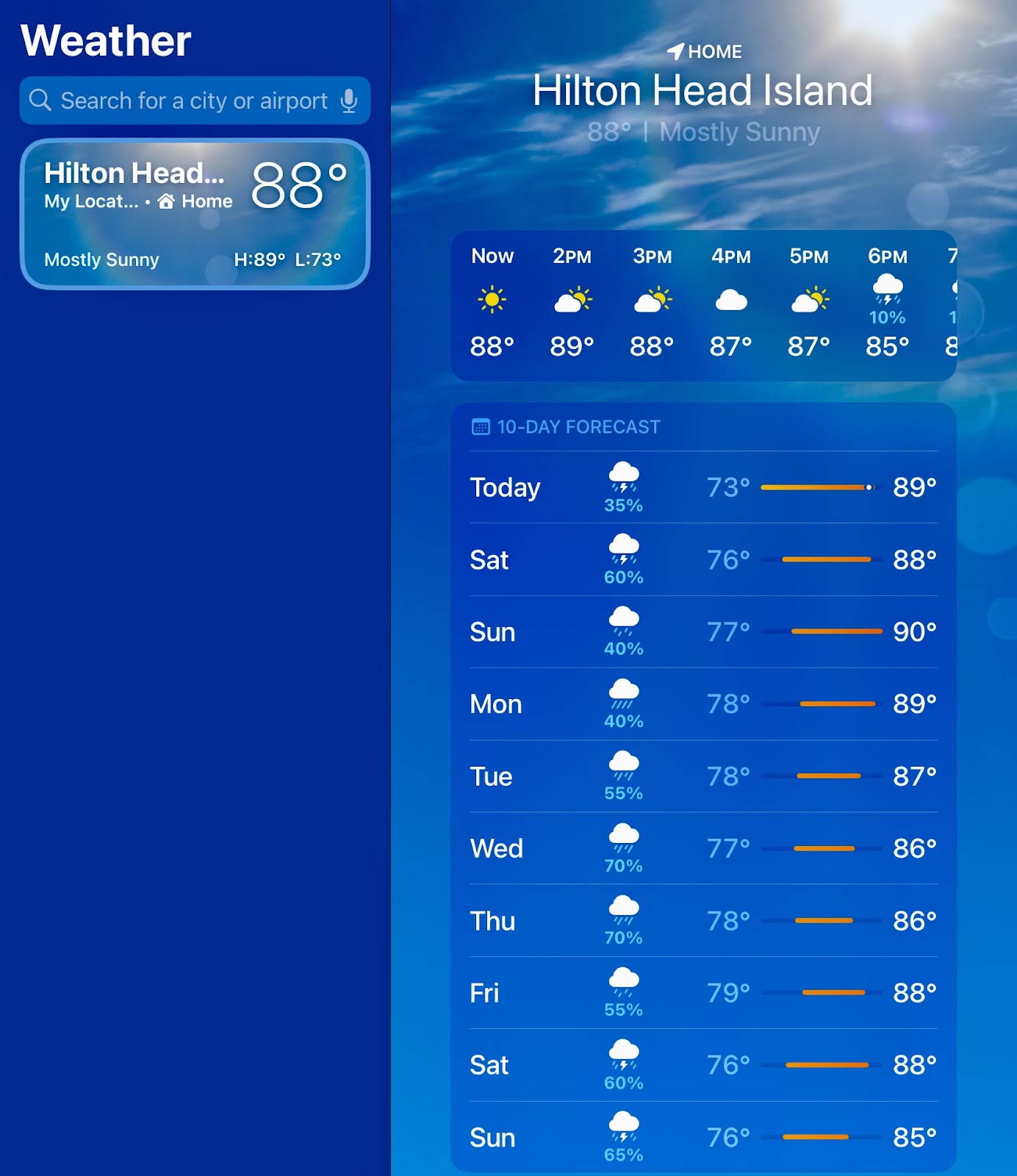
Summer heat is well established in the marsh. This is only normal, not the heat dome that caused places in the north to experience record temperatures. A friend in Montreal emailed that it was hotter there for a few days than in Hilton Heat and they don't have air-conditioning.
I googled and find that our species can not live long beyond what is called a wet bulb temperature greater than 95C/35C.
hottest-temperature-people-can-tolerate.html
This is not uncommon in summer in the Low Country, so my outside activity is limited to early mornings. I have gotten up and gone for 7 am bike rides four mornings in the past eight days. Once out there it is very pleasant. Sunrise. Few cars and a few people walking their dogs. But I like to linger in bed with a glass of juice and a cup of coffee reading what poses as the news and I have to force myself up. I will again tomorrow, and I will continue my afternoon workouts in air-conditioned bliss, and I will look forward to fall.
In rereading my books I have frequently been struck by how much the places to which I sailed have changed. This is not surprising when I reached them first almost fifty years ago. But the Australian coast north of Cairns has not changed. Not in fifty years. Probably not in 50,000 years. It is the Big Empty with beyond Cooktown almost no sign of man. I have now sailed it four times in four different boats and have called it my favorite coastal sail in the world. Wait until the southeast trades fill in about the beginning of May and you have beautiful reaching sailing day after day over relatively smooth water inside the Great Barrier Reef with good anchorages all but the penultimate night before reaching Cape York.
In rereading THE OCEAN WAITS I particularly enjoyed Chapter 3 in which I sailed that coast with the ghosts of Captains Cook, Bligh, and Edwards.
Here is that chapter.
Captain Cook fell asleep. He was entitled to be tired on this night of June 11, 1770. The Endeavour had been groping along the east coast of the Australian continent--New Holland to him--since sighting land south of present-day Sydney on April 19. The captain had no way of knowing about the Great Barrier Reef, its southern end more than a hundred miles offshore at latitude 23° South. Now, in a few more minutes, at 16º South, he would find out.
Still it had been a slow, trying, dangerous sail, with boats out to feel the way ahead and a watch kept in the bow, heaving the lead, day and night, for the last thousand miles. Thus far all had gone well, except for Mr. Orton, Cook's clerk, who had fallen asleep one night so drunk that he did not awaken when someone cut all the clothes from his back, and not being satisfied with this, later returned to his cabin and cut off parts of both his ears. Even by modern Australian standards, that was drunk.
There had been two pianissimo notes of warning. Just before sunset Cook had his first glimpse of a coral shoal, and around 9:30 P.M. the soundings suddenly began to lessen. The captain was on deck, but when the soundings returned to 20 and 21 fathoms before 10:00, he believed it was safe to stand on. He gave his usual orders for sailing at night along an unknown coast and retired to his cabin, where he stripped to his underwear and tried to rest. I doubt that he slept well. He had too much responsibility; there were too many unknowns, among them the question of whether the strait to the west that Torres had reported a century and a half earlier really existed. If it didn't, they might have to remain along this interminable coast all the way to China.
The wind was gentle and the sun bright as Chidiock Tichborne and I sailed those same waters two hundred years later, on the morning of April 23, 1981, our second day out of Cairns, where we had waited out the wet season. I had a detailed chart and unlimited visibility, and I knew my position perfectly. The reef where the Endeavour left her name and part of her bottom was only a mile to the east. Chidiock was being steered easily by the jib sheet, so I stood up, holding onto the mizzenmast, and stared across the sparkling water. There was not the least sign of coral. At night, the good captain did not have a chance.
A few minutes before 11:00, a cast of the lead from the Endeavour showed 17 fathoms. Before another cast could be made, the ship struck. By the time she hit the second time, Captain Cook was on deck in his drawers, but he was too late.
Captain Cook gave his orders with coolness and precision. Masts and yards were struck, boats put out to take soundings and set anchors, attempts made to winch the ship off. All to no avail. So they began to lighten ship. All night long, guns, ballast, casks, hoops, staves, oil, jars, decayed stores, everything that could possibly go overboard, did— twenty tons, thirty tons, finally almost fifty tons. Unfortunately they had gone aground at high tide, and the next high tide, at 11:00 A.M., was not enough by two full feet to lift them clear.
As that tide fell, the Endeavour began to take on more water. By noon two pumps were in operation; by mid-afternoon, three. The fourth was broken. But Captain Cook, ever the precise navigator, found time for a noon sight and noted a latitude of 15°45' South.
As Chidiock gurgled north, I pictured the Endeavour lying there on her side. We had the same fine weather. All afternoon they pumped, not just the men, everyone: Mr. Banks, the ship's officers, even Captain Cook himself. There was no panic. They worked steadily to exhaustion. After all, they were on the far side of the moon. It would be years before anyone in England started to miss them.
Captain Cook's thoughts were grim. All possibilities seemed bad. It did not seem likely that they could get the Endeavour off, but even if they did, she would probably sink before they could reach the mainland. There were not enough ship's boats to carry all the crew. If somehow they were able to beach the Endeavour, perhaps they could build a smaller ship from her timbers. But it seemed that even if they survived, Captain Cook's career was at an end.
He did not have much hope for the next tide, but he had to prepare as though he did. As night fell and the tide changed, he detached a few men from the pumps to jettison more stores and to maintain tension on the tackles running to the anchors.
Shortly after 10:00, the captain decided to risk all and heave the ship off if humanly possible. All hands who could be spared from the pumps were turned to the capstan and windlass. Exhausted muscles bunched beneath sweat-streaked shoulders for one last effort. The hull groaned. Drops of water sprayed from the bar-taut anchor lines. And at 10:20, with a sharp crack, the Endeavour floated free. The ship had 3 feet 9 inches of water in the hold. Captain Cook admitted to feeling fear for the first time. The man taking the depth of water in the well was relieved by another, who took the measurement in a slightly different spot. The difference was an immediate 18 inches. Until the cause was discovered, it seemed certain the Endeavour was going down fast.
I wonder what we would have known today of Captain Cook if the ship had sunk. Despite all his qualities of greatness, he was saved now, as he soon would be again a few hundred miles farther north, by chance. That final crack as the Endeavour slipped from the reef was made by a piece of coral breaking off, and the coral remained with her, plugging the hole in her hull.
Captain Cook scattered his emotions along that coast of green mountains 2,000 to 4,000 feet high. Cape Tribulation, named because it was where his troubles began, lay to the south of me. Abeam lay Weary Bay, where the Endeavour was slowly towed by one of the boats, while another searched the coast for a spot where the ship could be beached. They found it at the mouth of what is now the Endeavour River, twenty miles north, but they needed three days to get her there. And still out of sight to the north was Cape Flattery, which falsely flattered them into believing that the worst was over.
When I had raised anchor that morning at 4:00 A.M. I planned to go into the old mining town of Cooktown, on the Endeavour River, but already I had changed my mind. At 11:00 A.M. the wind was too good to waste, and by noon it was too strong to risk crossing the bar. In my mind I watched Cook's men work the Endeavour in. They touched bottom twice, took a week to make repairs, and then were trapped for more than a month by the south easterlies before they could get back out. During that enforced respite, they became the first Europeans to see a kangaroo, and Captain Cook made a chart of the river that one could use today.
But although I wanted to think of Captain Cook, Chidiock was going like a bat out of Bullamakanka. The forecast at Cairns had been for twenty to twenty-five knot winds and rough seas. Just before we left, a powerboat had come into Cairns and created a new standard for anchoring on top of Chidiock, tied as she had been for five months fore and aft to a permanent mooring. When his dinghy hit Chidiock at low tide, the powerboat's owner casually remarked, "I think you're dragging into me," and when I raised sail, he said, "You're not going out in that?" I wasn't sure whether he meant Chidiock or the weather or both, and did not bother to ask.
The wind had not been bad, though, and we had made good progress that first day, and better the second even before the wind piped up to the forecast force and Chidiock began surfing at ten knots amidst miscellaneous bits of coral. Although I kept the jib tied to the tiller, I had to do most of the steering, and the result was a slight problem when I set a course for a distant headland I thought to be Cape Bedford and could not look under the jib again until the real Cape Bedford made an unexpected appearance directly ahead and, lamentably, somewhat to windward of us. There was no time to bother with foul weather gear as I hardened up to a close reach to fight clear. I was somewhat bedraggled by the time I dropped anchor at sunset in Cape Bedford's comfortable lee.
The next morning I was awake and sailing before dawn in what was to become the established routine on this—for me—unique coastal passage. With dawn after 6:00 A.M. and sunset less than twelve hours later, an early start was imperative, and we were always underway less than ten minutes after I awakened. Anchoring in less than a fathom of water, I would sit up, extricate myself from the tarp, which seems capable still of devising new ways of trying to suffocate me, insert the rudder, unfurl the mizzen and jib, and raise the anchor, and we would be gliding across the dark, usually smooth water. Everything else could be attended to while underway. Inside the Great Barrier Reef there are just too many dangers, unless one sticks to the main shipping channel, which for Chidiock has its own disadvantages. I had planned our stops so that we would cover the 550 miles to Cape York in ten days, and en route we reached our intended stop every night but one, when we were becalmed.
A few people who had sailed this coast had not spoken well of it, but its isolation suited my mood exactly. Beyond Cairns there is nothing much except for the shipping in the main channel and the prawn boats, many of which were in the various anchorages as I entered. I was glad that the prawn fishermen and I were working different hours. I was on the day shift and they were on nights. We nodded as we passed—I on the way in to anchor, wash myself, and with an anxious glance for crocodiles, dive overboard to rinse off, while they were preparing their nets. At sunset, while I was heating my dinner, they turned on their bright deck lights, upped anchor, and chugged away. At times they seemed to me like ponderous ballerinas performing an obscure dance, and I was always relieved when they were gone. It had been years since I had made so long a coastal passage, and this one reinforced my belief that, while interesting, sailing beside land is more tiring than being offshore. The wind is less reliable; the waves more confused; currents stronger, dangers more numerous; and demands on attention greater. Aboard Chidiock, my skin even suffered as much as it does at sea, because the weather was too hot for foul weather gear, and while the seas were mostly low, the odd wave always managed to find its way aboard. But I was able to stand up part of each day while at anchor and usually even while sailing, so the circulation in my legs did not suffer.
On probably no other ocean-going vessel does simply standing up change your perspective more than it does aboard Chidiock, so I found many reasons to stand. The Admiralty pilot says of one cape that "from a distance it appears to be an island." This is not terribly useful when all capes appear to be islands if viewed from true sea level, as they are by one sitting in Chidiock, and that particular day, with land a mile away, I took a noon sight to determine which of several rather nondescript points was abeam.
More even than the solitude and isolation and generally fine sailing—for after the first two days we had only moderate winds except for a morning squall near Cape Direction and a few brief showers near Torres Strait—I enjoyed that coast because of its history. Captains Cook and Bligh and Edwards, and the unfolding of the Bounty mutiny, were all there. The coast, the sea, the season, the weather, all were as they had been. Only a little imagination was needed to bring the past to life. I even used a copy of Captain Bligh's chart for the last hundred miles.
As I sailed on, I was first rejoined by Captain Cook, who, upon extricating himself from the Endeavour River, followed the true sailor's longing for sea room and tried to get away from the coast and this maze of coral he called the Labyrinth. In this case it was the wrong decision made for the right reasons. I have made a few of those myself. For although he could not know it, there was no sea room for hundreds of miles in what was to become known as the Coral Sea. He did find his way through the main body of the reef beyond Lizard Island, only sixty miles north of Cooktown. The relief leaps from the page of his journal for Tuesday, August 14, 1770, when at last the Endeavour is beyond the breakers and for the first time in more than a thousand miles there is no bottom at 150 fathoms.
But no sooner had he safely escaped, as he thought and hoped, from the coral, than the land began to toy with him. For hundreds of miles the coast had been high, green, and tending north. Now the hills became lower and browner and fell away sharply to the northwest. The worried captain had no choice but to follow in this new direction, hugging the outside of the reef, which is a most unforgiving lee shore.
As I skirted Cape Melville on April 25, I saw the trick of geography that almost killed him. Beyond Cape Melville, which is so brown and boulder-strewn it reminds me of Baja California, the coast falls away to the south in a fifty-mile arc. From my boat I could see, fifteen miles ahead, the islands of the Flinders Group, and then, although I knew the coast was there, nothing.
Outside the reef, Captain Cook became more anxious with each succeeding mile. His job was to chart the coast, and he couldn't even see the bloody thing. He was also supposed to locate Torres's strait and determine conclusively whether New Guinea and New Holland were joined by land. Perhaps that void over there was the strait. The only way to find out was to go back through the coral, an irony that was not lost on the captain, as he recorded the happiness with which he re- encountered "those shoals which but two days ago our utmost wishes were crowned by getting clear of.”
On Thursday, August 16, the lookout thought he saw the termination of the reef, and they sailed in. Only when the ship was too close for retreat could the men see that what they were approaching was just a narrow pass. The wind died, and they were becalmed. Inexorably the tide carried them toward the coral. Boats were set out, but although they were able to get the Endeavour's bow around, they could not tow her off. Helplessly they drifted closer, just as I had during my last circumnavigation, in my engineless thirty-seven foot cutter in the pass at Papeete.
No wind, a tide setting the boat onto a reef, no bottom for the anchor. I too had kept my bow pointed seaward toward a nonexistent wind. I too had kept watching the line of surf edge nearer. I too had known, as Captain Cook must have, that I alone was responsible for getting into the predicament. I too had hoped, as he must have, for something, anything, salvation. And I too was saved, as he was, by chance. If you go to sea, you had better know what you are doing, you had better be self-reliant, you had better be strong and persevering; but if you put yourself at risk long enough, you had also better have some luck.
At 7:00 P.M. on December 23, 1974, my cutter, Egregious, was where the Endeavour was at 4:00 P.M. on August 16, 1770. Let Captain Cook say it: ". . . between us and Destruction was only a dismal Valley the breadth of one wave." And then, when we were both considering what we would do after the inevitable wreck, a shadow of a whisper of a breath of breeze reached us both, and ever so gradually we edged our way clear—I to the open ocean and a minor disaster in the Roaring Forties, the good captain to a safe passage through the reef the next day and then a relatively uneventful sail to Cape York.
Again in Captain Cook's words, echoed by all aboard who ever wrote about his voyage: ". . . this is the narrowest Escape we ever had." To that point in our respective careers anyway.
We are accustomed to think of Captain Cook after his apotheosis into the Great Navigator, arguably the greatest. But we forget that on this first voyage he was not so secure. He did not come from the British Establishment. His father was a farm laborer, and Cook had risen from the ranks through merit in an age when Family and Influence were all-powerful. If he failed to satisfy his masters on this his first important command, there were countless other men in the Royal Navy clamoring to make the next great voyage of exploration. So Captain Cook felt the need to justify himself in his log: "Was it not for the pleasure which naturally results to a Man from being the first discoverer, even was it nothing more than sands and Shoals, this service would be insupportable especially in far distant parts, like this, short of Provisions and almost every other necessary. The world will hardly admit of an excuse for a man leaving a Coast unexplored he has once discovered, if dangers are his excuse he is then charged with Timorousness and want of Perseverance and at once pronounced the unfittest man in the world to be employ'd as a discoverer; if on the other hand he boldly encounters all the dangers and obstacles he meets and is unfortunate enough not to succeed he is then charged with Temerity and want of conduct."
In other words, no matter what a sailor does, some self-styled expert sitting comfortably ashore will say it was the wrong thing. Thank you, Captain Cook, from all of us who explore uncharted coasts of the human spirit.
The wind was blowing hard as I drove Chidiock toward Cape Direction. Providential Channel, where Cook re-entered the reef, still lay a few miles north, when through the rain I caught a glimpse of a tattered sail. Then the rain closed down. The waves were only three feet high, but uncomfortably steep and close together. It seemed that Chidiock was being set inside Cape Direction, and remembering Cape Bedford, I did not relish the possibility of having to harden up again to get clear. I concentrated on steering, so the call "Ahoy, Chidiock Tichborne" took me by surprise. I ducked under the loose foot of the main, and there, a few boat lengths to windward, was another open boat, a few feet longer than Chidiock, lug-sailed, deeper, and filled with men, so many I could not count them, sprawled all over one another. Their clothes were in shreds and they were obviously starving, but their faces were filled with joy. The figure at the tiller was recognizable, although a mere shadow of the well-fed ghost I had seen pacing the waves off Tofua Island almost two years earlier. "Young man," he called, "what took you so long?"
"Captain Bligh, I appreciate the 'young,' but I am in fact four years older than you as I see you today."
The nearness of land after the 2,600 mile sail from Tofua had tempered his usual choler. He even smiled as he replied. "Well, you are and you aren't. I may be only thirty-five, but that was my age back in 1789. I repeat, what have you been doing since we lost sight of one another in the Feejees?"
A gust caught the Bounty's launch and drove her down on Chidiock and for a moment we were both occupied with preventing a collision. By the time the gust had passed, Chidiock had pulled ahead, and I eased the mainsheet to enable the launch to come back within hailing distance. "She sails well," he called.
"But I am not so heavily laden as you," I said. "It would be interesting, though, to see how they sail just man for man."
The captain's spirit was incredible. Despite his ordeal his eyes gleamed. "Perhaps . . . no . . . it simply can't be done." He gestured toward the crew, all of whom were staring eagerly toward an island off a cape ahead. "History is what it is."
"They cannot see me?" I asked.
"No. Only I can. One of the many peculiarities of this ghost business. You were saying?"
"After leaving Chidiock in Suva for the rainy season, I set out again in May. Three days later we hit something that was floating in the sea.
We were then halfway to Vanuatu, as people now call the islands where you tried to land but were driven off by the natives. I was shipwrecked farther down the chain. They gave me a somewhat better welcome than they did you."
The land was near, with gusts and cross seas curving around the high eastern side of the island, and for a while Chidiock again moved ahead. When we were in the lee, I hove to and reached for the Nikonos camera. The Bounty's launch came on. "I'm going ashore here," said the captain, pointing at a narrow strip of sand.
I took the photograph. "It will not come out," he said. I shrugged. "Worth a try. It is said that there is a better anchorage beyond the point." "I don't trust the natives on the mainland." "But there is no one there." "Not for you, but for me they are waving clubs and making threatening gestures." His voice became querulous. "You know I go to the island. Restoration Island I name it, both for the restoration of my ship's company to life and for the restoration of Charles II to the throne. It never did an officer harm to flatter the Crown, even if as individuals princes are more meretricious than meritorious. Do you sail in the morning?"
"Yes."
"Ah well. We will stay here for two days. The men need to regain their strength." A scowl crossed his face. "Though as soon as they do, they will become insolent and that fool Lamb will almost kill himself by gorging down nine raw birds. Scum hardly worth saving, but it is my duty."
I watched the much-maligned man head in to the island. The more I had studied him, the more I became convinced that in all the great moments in his life—the Bounty mutiny, his service with Duncan at Camperdown and Nelson at Copenhagen, the Rum Rebellion when he was governor of New South Wales—he had not only been right but had also done his duty properly.
The launch was almost at the beach before I realized that we would probably not meet again. "Captain?" I called.
"What?" He was brusque now at the interruption.
"For two years I've been wondering, was that really marmalade I saw on your vest off Tofua?"
"Yes," he grunted and turned back to steer through the shore break.
I started to ask where he had obtained marmalade, but then even a ghost must want to get ashore after 2,600 miles in an open boat, and, reluctantly, I jibed Chidiock and sailed to join the prawn boats at Portland Roads. The mystery of the marmalade would remain unsolved.
I was right. I never did see Captain Bligh's ghost again, although the next night I anchored within sight of Sunday Island, his second anchorage, where he had handed a sword to William Purcell, the carpenter, and told him to either obey orders or fight. Purcell chose to obey. But I did observe from a distance the final scenes of the Bounty saga.
Two days north of Restoration Island, I looked seaward toward the reef where the egregious Captain Edwards wrecked the Pandora.
Immediately upon Bligh's return to England, the Admiralty dispatched Edwards in the twenty-four gun frigate Pandora to track down the mutineers. The Pandora made for Tahiti via Cape Horn. At dawn on March 17, 1791, the ship passed just north of Pitcairn Island, where Fletcher Christian successfully sought oblivion; but the Pandora sailed on, and Edwards had to settle for those mutineers who had unwisely remained in Tahiti, along with the men who, although always loyal to Captain Bligh, had been prevented from joining him in the launch.
Edwards tossed them all, loyal crewmen and mutineers alike, into a small round deckhouse in the stern, which naturally became known as Pandora's Box. The Box could be entered only through a twenty inch hole in the top. It was hot and foul, and the prisoners were kept constantly in leg irons. Edwards intended to return to England via Cook's Endeavour Strait. When Bligh learned of this, he predicted that Edwards was not seaman enough to make it. And again Captain Bligh was right, for on the night of August 28, 1791, after a three day search for a pass through the coral, the Pandora went onto the reef.
Edwards can be forgiven for not being a Captain Cook or a Captain Bligh. He cannot be forgiven for permitting the ensuing panic, although apparently someone did forgive him, for he died in 1815 an admiral. The ship took on ten feet of water in twenty minutes, but she did not sink for several hours. Still, thirty-five men drowned, including four of the "mutineers," whom, despite their pleas, Edwards refused to release from Pandora's Box. That any of them survived was due only to Will Moulter, the boatswain's mate, who risked his life to unbolt the scuttle and toss down the key to their irons. Ever true to his nature, Edwards was by no means the last to leave the sinking ship.
In four boats, the survivors proceeded to Kupang, where they arrived on September 15. Two of Edwards's lieutenants, Hayward and Hallet, had had the pleasure of being midshipmen with Bligh, and thus found themselves reaching Kupang for the second time in a little over two years in an open boat. History does not seem to have recorded their comments, perhaps because in any age but ours their comments were unprintable.
And from the anchorage in the lee of Cape York, I could look north toward the channel Bligh surveyed when he returned to Torres Strait a year later, in September 1792, in command of the Providence. He had been commissioned to return to Tahiti to fulfill the Bounty's original mission of transporting breadfruit to the West Indies, where it was to be used as cheap food for the slaves. The main shipping channel through the strait still passes through Bligh Entrance from the Pacific.
I smiled to myself as I sat aboard Chidiock Tichborne on my rest day at Cape York and recalled that this time Captain Bligh was successful. The breadfruit reached the West Indies, where, as expected, the trees flourished. The grateful planters even gave Bligh an expensive gift, but their gratitude was premature. The inconsiderate slaves hated the taste of breadfruit and starved rather than eat the loathsome stuff. If heroism and folly were not equally their own justification, one might even believe that it all had been in vain.
A white heron squawked as it flew over Chidiock, and brought me back to the present. Of all people, lone sailors should not examine heroism and folly too closely.