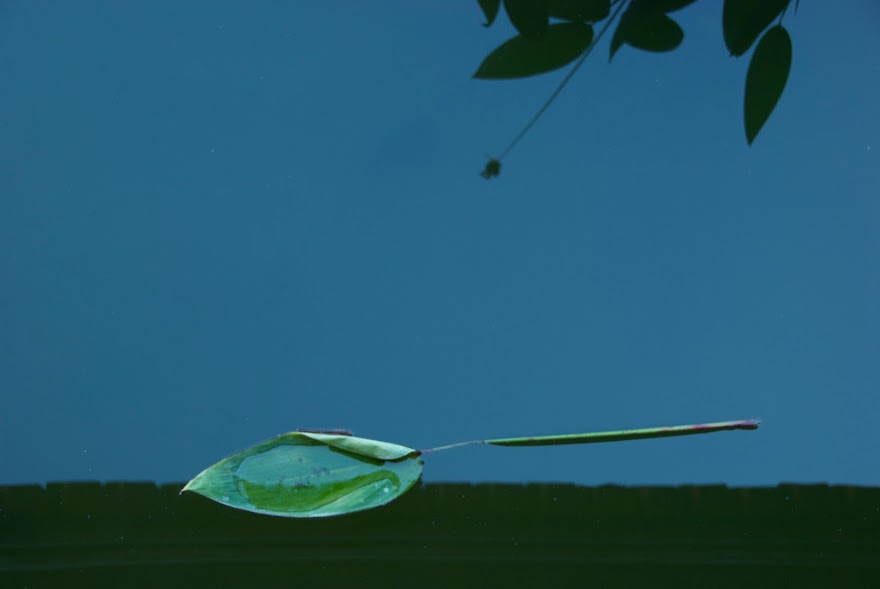
I thank my friend Michael for forwarding me the following from the famed mountaineer, Reinhold Messner.

Michael and his wife, Layne, retired a few years ago to life in a Dodge van with a custom interior on which they have travelled the U.S., Central and South America. It is much like living on a boat. They are about to enter Uruguay, the nineteenth country on their voyage. This reminded me of something I wrote while in Uruguay with Jill in 1992 after a 6,000 mile passage on RESURGAM from Auckland around Cape Horn. We sailed into Punta del Este, but then rode the bus to the capital, Montevideo, to obtain our visas for Brazil.
We rode the bus for a couple of hours through a gently rolling countryside and came to a city of narrow streets, elaborately carved doors, iron balconies and trees. The trees are squeezed everywhere and line streets, often joining branches overhead. In Montevideo you feel that you are in a Spanish city, while in Punta del Este you do not.
Between visits to the Brazilian Embassy, we walked around the waterfront. The mouth of the Rio de la Plata is wide--the Argentine side is 50 miles from Montevideo--and shallow. Major shipping is confined to narrow channels dredged in those 50 miles.
On one side of the city, near the container facility, stands a neglected statue of a conquistador, staring determinedly inland. Beyond him is the stone wall of a decayed fort. This is an old part of the New World. Isla de Lobos, near Punta, claims to be the site of the first lighthouse in the Americas. Only after sailing due west for several days would early adventurers have seen the south bank or known they were on fresh water.
On the other side of Montevideo, a promenade runs along the shore. Late one weekday afternoon, it held a curious tableau.
Montevideo is not the mixture of urban and rural that one often finds in Asia and Africa. It is definitely a city. Yet in a park in front of an apartment building in the old part of town, we saw a goat kneeling to eat grass. A boy turned the corner from one narrow alleyway to another, riding a fine gray horse. Fishermen perched on the seawall, dangling hopeful lines in the choppy water.
We passed two couples, sitting on benches partially sheltered by the seawall. They were only a few steps apart but oblivious to one another. The first couple were young lovers. The second, dressed all in black, were a middle-aged man and an old woman. The woman, whom we assumed to be his mother, was quietly crying. They seemed just to have come from a funeral. Both couples were the same: a man with his arms around a woman, whose face was buried against his chest. The embraces of love and death identical.
We walked back up the hill into the center of the city where, at a cafe beside the Plaza Independencia, we shared a bottle of wine in the evening dusk and watched pigeons settle on the statue of Artiga, Uruguay’s George Washington.
I have read that cruisers power about one-third of the time.
In writing GANNET 6 I came to wonder how much I powered the little boat.
The daily runs for GANNET’s circumnavigation total 29,989. Of those I powered less than 15.
Out of San Diego 1 mile.
In Hilo .5 mile.
In and out of Honolulu 2 miles
In Apia .5 mile
In Vavau 1 mile.
In Opua .5 mile.
In Bundaberg .5 mile.
In and out of Durban 3 miles.
In St. Helena .5 mile.
Out of Marathon .25 mile.
In Hilton Head 2 miles
In Balboa .5 mile.
In San Diego .25 mile.
I left Hilo, Apia, Vavau, Opua, Bundaberg, St. Helena, Hilton Head, and Balboa under sail.
GANNET was also towed at St. Lucia about 1 mile and into Marathon about .5 mile.
This works out to about 1/2000th powering. Obviously GANNET and I are not cruisers.
With an electric outboard whose battery is recharged by the ship’s batteries which are charged by solar power we spent nothing on fuel. However, having bought two electric outboards and a spare battery during the voyage our cost were a startling $266 per mile.
Those are two amazing numbers, Webb. 15 miles powered costing about $4000. I used the diesel engine on Sea Change far too much, should have used the asymmetrical spinnaker at least a bit, but the total cost came to about the same. I put about 1000 hours on the engine. A good proportion of that was anchoring, but leaving that aside, assume I averaged 3 miles per hour, that is 3000 miles out of at least 25,000, or 1/8 of my circumnavigation. Assuming average diesel cost of $4 per gallon, and 3 hours per gallon, that comes to about $1200, plus repairs for two transmissions at $1000, plus a new water pump for $1000, two alternators for about $500, and four engine mounts for $400, plus miscellaneous cost of maintenance, perhaps $400, puts me around the same total of $4400, but at considerable carbon emission cost.
ReplyDeleteAlthough I powered far less than you--and you powered far less than most circumnavigators--and I spent nothing on fuel, counting buying two electric outboards and an extra battery I spent almost as much to power as you did.
ReplyDelete